

GoodNotes 6 has the strongest in-app handwriting recognition on iPad in 2026. It handles printed and cursive handwriting better than Apple Notes’ Copy as Text, includes Apple’s Scribble for live conversion in text boxes, indexes everything for search across notebooks, and converts hand-drawn maths equations as well as text. Where it stops short is imported content: scans, photos, PDFs from other sources. For those, you’ll route through a dedicated handwriting OCR.
This guide covers each method with concrete steps, realistic accuracy figures, and what to do when GoodNotes’ built-in tools aren’t the right fit.
Quick start: lasso, convert, done
- Write on the page with your Apple Pencil or finger.
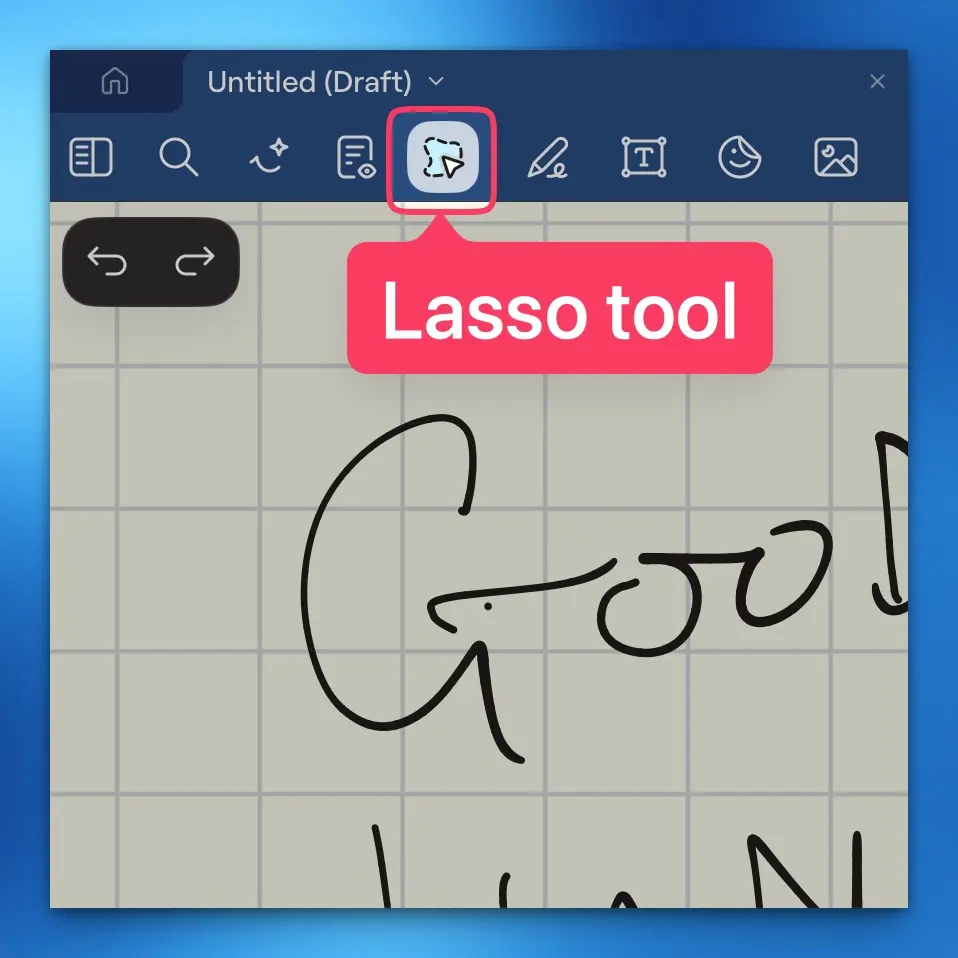
- Tap the Lasso Tool icon in the toolbar.
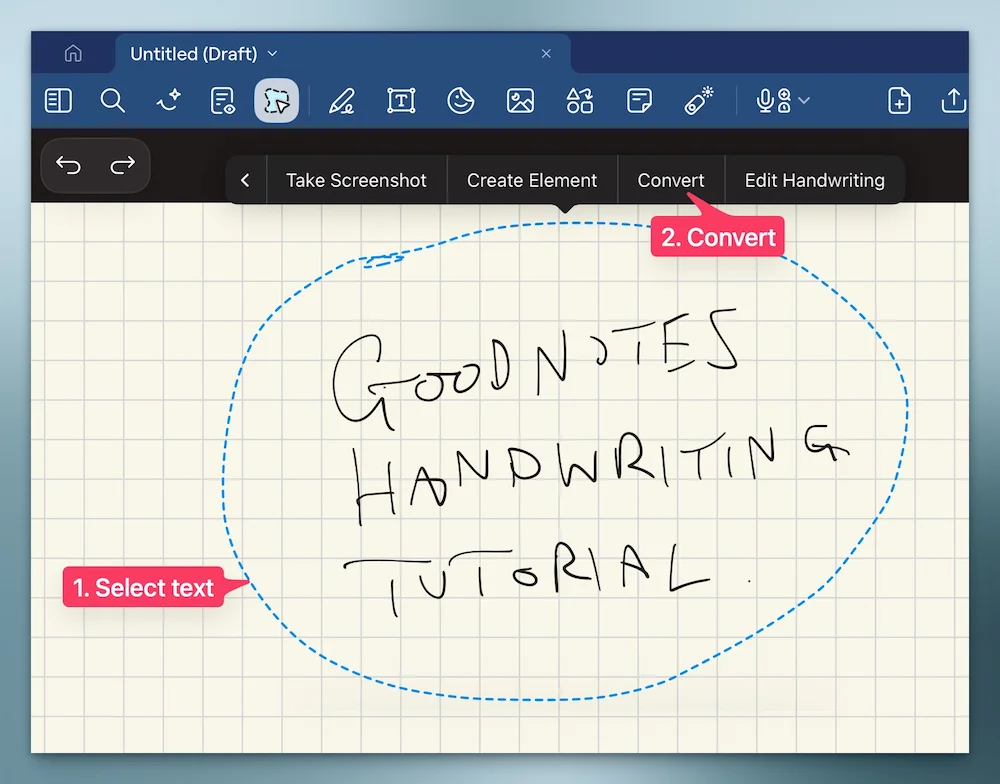
- Circle the handwriting you want to convert.
- Tap the selection and choose Convert → Text.
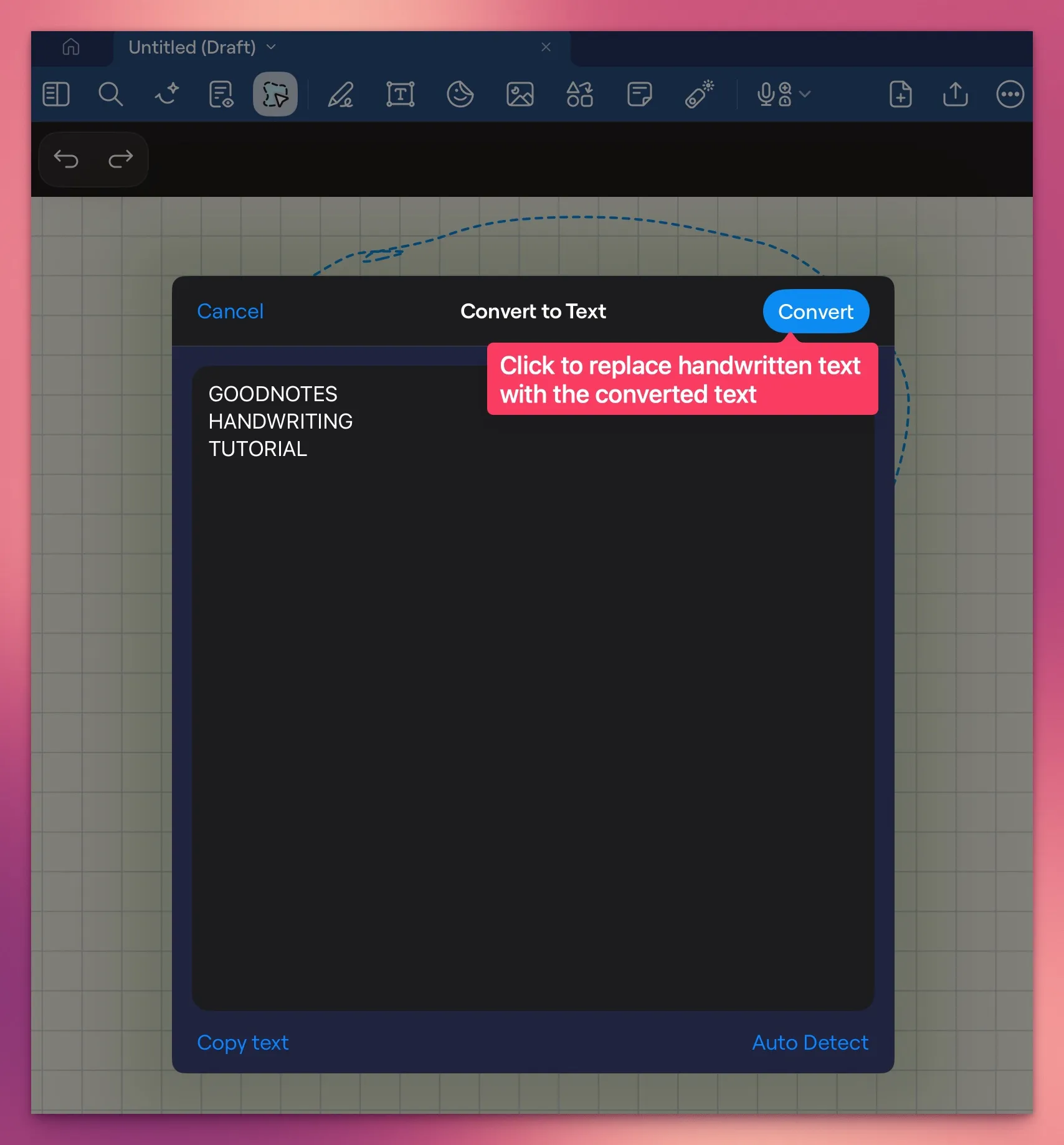
- Review the preview, fix any errors, then tap Convert to replace the ink with typed text, or Copy Text to send it to the clipboard.
That’s the whole workflow for converting handwriting you’ve already written. The rest of this guide explains the other methods (Scribble for automatic conversion, search for finding handwritten notes, Maths conversion for equations) and what to use when the source isn’t ink you wrote in the app.
Quick takeaways
- Two methods built in: Lasso Tool (manual, on existing ink) and Apple Scribble (automatic, inside text boxes).
- Accuracy: 90% to 95% on neat printing written with Apple Pencil; 80% to 90% on cursive; 5 to 10 points lower on finger input.
- Cannot OCR imported images or PDFs. Both Lasso and Scribble only operate on ink strokes you create in GoodNotes.
- Search works without conversion. All handwritten content is OCR-indexed in the background across 30+ languages.
- For paper documents and old archives: scan or photograph the page, run through a dedicated handwriting OCR, paste the typed result back into GoodNotes if you want it there.
Quick decider: which GoodNotes feature fits your situation
| You have | Recommended path | Realistic accuracy | What you need |
|---|---|---|---|
| Existing handwritten notes in a GoodNotes notebook | Lasso Tool → Convert → Text | 90% to 95% on print, 80% to 90% on cursive | Apple Pencil or finger |
| You want clean typed text as you write | Text Tool to create a box → Scribble | 90% to 95% on print | Apple Pencil, iPadOS 14+ |
| Maths equations written by hand | Lasso Tool → Convert → Math | Good on undergraduate maths | Apple Pencil |
| You can’t read a specific handwritten note from yesterday | Search bar (no conversion) | Background OCR, instant | Any input |
| A photo or scan of paper handwriting | External handwriting OCR + paste into GoodNotes | 95%+ on legible cursive | Browser, any device |
| 30+ pages of handwritten archive | Export notebook as PDF → external handwriting OCR | 95%+ | Same |
Method 1: The Lasso Tool
The Lasso Tool is the primary handwriting-to-text feature in GoodNotes. It works on any ink you’ve drawn on the page, preview-first, with the option to either replace the original ink with typed text or just copy the text out.
Step by step
- Activate the Lasso Tool. Tap the lasso icon in the toolbar (usually around the fifth or sixth icon from the left).
- Circle the handwriting. Draw a loop around the ink you want to convert. Be generous: include a little space around descenders and ascenders. You can select a single word, a paragraph, or multiple separate sections in one pass.
- Open the selection menu. Long-press the selected area until the popup menu appears.
- Pick Convert. Tap Convert, then choose either Text or Math depending on what you selected.
- Review the preview. GoodNotes shows the recognised text. Fix obvious errors by tapping in and editing: misrecognised letters, missing punctuation, joined-up words.
- Replace or copy.
- Convert replaces your handwritten ink with typed text in the same position, matching the size and colour of your original writing.
- Copy Text keeps the handwriting intact and copies the typed version to the clipboard for pasting elsewhere.
When the Lasso Tool is the right choice
- Reviewing the conversion before committing.
- Converting selected parts of a page (a single equation, a specific paragraph) without touching the rest.
- Working with messy handwriting where you want to spot and fix errors before they become typed text.
- Working without an Apple Pencil (the Lasso Tool runs on finger-written ink too).
Lasso Tool: Convert → Math
Maths handwriting is a separate conversion target. Lasso a hand-drawn equation, tap Convert → Math, and GoodNotes recognises standard mathematical notation: fractions, square roots, integrals, summations, Greek letters, subscripts and superscripts. Output renders as proper maths typography you can copy to other apps. Accuracy is solid on undergraduate-level maths; bench-science notation, music theory and chess notation are outside what it’s trained on and will produce mixed results.
Method 2: Apple Scribble inside text boxes
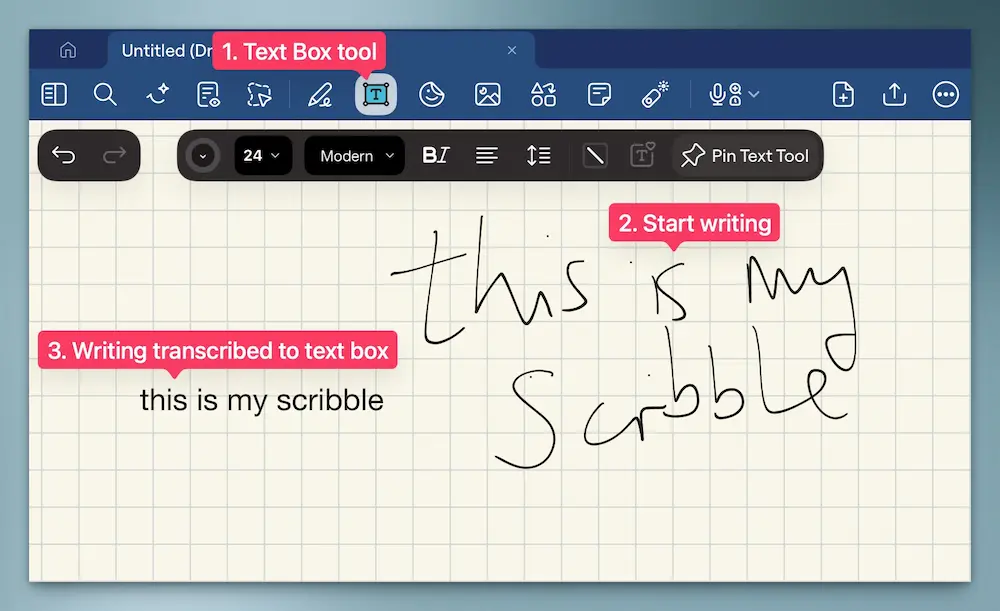
Apple’s system-wide Scribble feature works inside GoodNotes too, but only within text boxes (not on the regular handwriting canvas). The conversion happens live as you write.
Step by step
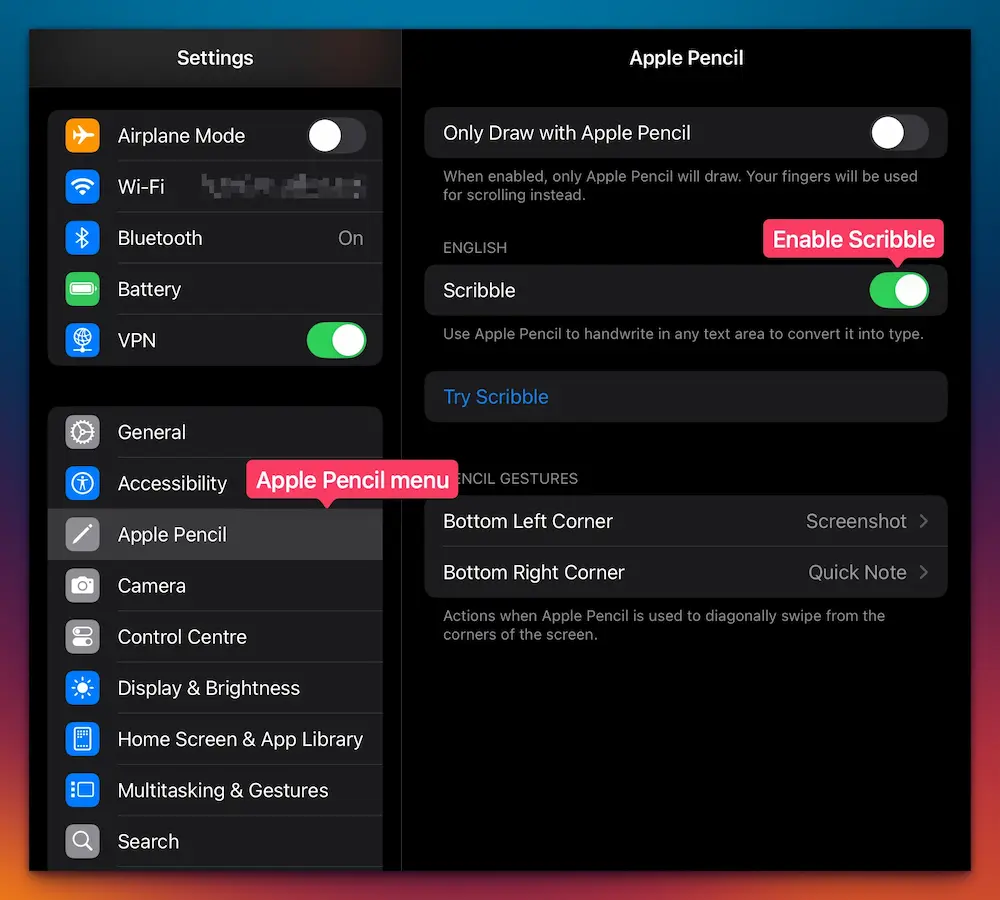
- Enable Scribble once. Settings → Apple Pencil → Scribble → on.
- In GoodNotes, tap the Text Tool (T). This creates a text box on the page.
- Write anywhere on the page with your Apple Pencil. The ink converts and the typed text appears inside the text box.
- Edit normally. Because the result is already typed text in a text box, you can change the font, size, colour or position with the Text Tool. Standard text editing applies.
When Scribble is the right choice
- Live note-taking in lectures and meetings where you want typed output immediately.
- Filling in form-like layouts where neat typed text matters.
- Adding labels and captions that look clean in the final document.
Limits
- Apple Pencil required. Finger writing does not trigger Scribble.
- Only inside text boxes. Writing on the bare page does not auto-convert. Use the Lasso Tool afterwards if you change your mind.
- No preview step. Errors get committed instantly. Cursive that joins ambiguously sometimes catches Scribble out.
Method 3: Search without converting
A feature that’s worth knowing about even if you never run an explicit conversion: GoodNotes indexes all your handwritten content in the background. Open the search bar from the library view, type a word, and you get back every notebook and page where that word appears in your handwriting, with the matches highlighted.
This is the right feature when you don’t need typed text in the document, you just need to find the handwritten note that mentioned a specific thing.
Background indexing covers 30+ languages and works on both Apple Pencil and finger-written ink.
Lasso Tool vs Scribble: side-by-side
| Feature | Lasso Tool | Scribble |
|---|---|---|
| Requires Apple Pencil | No (finger works) | Yes |
| When conversion happens | After writing (manual) | While writing (automatic) |
| Preview step | Yes, edit before committing | No |
| Works on the page canvas | Yes | No (text boxes only) |
| Best for messy handwriting | Better (review-first) | Worse (no second chance) |
| Speed for one-off conversions | Slower (manual selection) | Faster (live) |
| Works on imported images | No | No |
| Maths conversion | Yes (Convert → Math) | No |
When GoodNotes built-in tools aren’t enough
The hard limit of every in-app handwriting feature (in GoodNotes, Apple Notes, OneNote, Notability) is the same: they only work on ink you created inside that app. They cannot read text from photographs of paper, scanned PDFs, screenshots of whiteboards, or images imported from outside.
For those situations the workflow is:
- Capture the document (phone photo, document scanner in Apple Notes, dedicated scanner, etc.).
- Upload to a dedicated handwriting OCR service.
- Paste the typed text into GoodNotes (or wherever you want it).
Accuracy comparison on the same paper sources
| Document type | GoodNotes built-in (ink only) | Dedicated handwriting OCR (image or PDF) |
|---|---|---|
| Neat block-letter handwriting | 90% to 95% (only if you re-wrote it in app) | 95%+ |
| Modern cursive on paper | Not applicable (imports unsupported) | 95%+ |
| 1800s copperplate or Spencerian | Not applicable | 90%+ |
| Sütterlin or Kurrent (German cursive) | Not applicable | 70% to 85% |
| Photos of whiteboards | Not applicable | 90%+ on neat board writing |
| Languages | 30+ (in-app handwriting only) | 300+ |
Skip the upload: email notes straight from GoodNotes
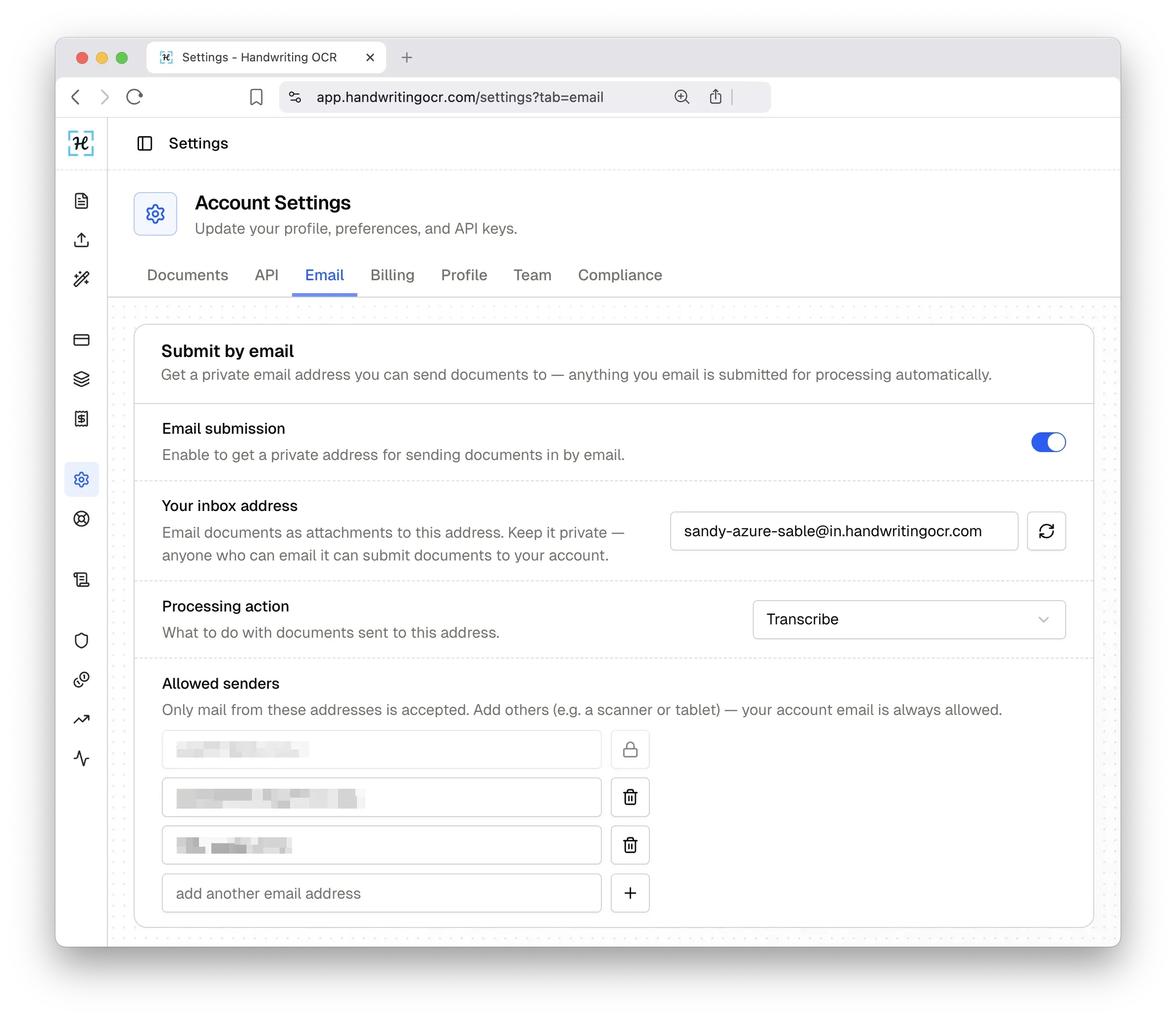
New in 2026, you can email documents to a private Handwriting OCR inbox and have them transcribed automatically, with no upload step. In GoodNotes, use Share → Export → PDF and send it to your private inbox address (set one up under Settings → Email in Handwriting OCR, then allow-list the account you send from). The pages come back transcribed in your dashboard, usually within 15 to 20 seconds, so a whole notebook exported as one PDF clears a backlog in a single email.
Every day our recognition models read thousands of pages of real handwriting, which is why Handwriting OCR handles the cursive, faded ink and historical scripts the in-app tools can’t.
The workflow with a dedicated OCR
- Photograph or scan the page. For multi-page archives, the document scanner in Apple Notes is good (Notes → camera icon → Scan Documents) because it auto-deskews and produces a clean PDF.
- Upload the image or PDF to Handwriting OCR. Free trial credits, no card needed.
- Pick Extract full text. Output appears in 15 to 30 seconds per page.
- Copy the typed text and paste into a GoodNotes text box, or download as Word and import.
For longer batches (a whole notebook), the time saved on manual correction is the deciding factor: a 50-page archive that would take 12 to 15 hours to retype manually goes through in 25 to 30 minutes including review.
Common GoodNotes troubleshooting
“Convert” is greyed out. You haven’t selected ink. Switch to the Lasso Tool (not the Pen or Eraser), then draw a loop around handwritten strokes. Imported images and text boxes are not convertible.
Conversion accuracy is consistently poor. Three things to check before assuming it’s the handwriting. (1) Document language: open document settings and confirm the language matches your writing. The recogniser uses language context. (2) App version: each GoodNotes release tends to ship recognition improvements. (3) Stroke clarity: writing slightly larger, with consistent spacing, lifts accuracy 5 to 15 percentage points in our testing.
Scribble isn’t appearing. Apple Pencil paired? Settings → Apple Pencil → Scribble on? Inside a text box (not on the open page)? Those three cover most causes.
Converted text has the wrong style. Expected behaviour: Lasso Tool conversion preserves the size and colour of your original ink; Scribble uses the default text style of the text box. To restyle, double-tap the converted text and use the Text Tool.
Tips that move accuracy
A few habits that move recognition by 5 to 15 percentage points without changing how you write much:
- Write a fraction larger and slower. Both help the recognition model significantly.
- Leave a clear gap between words. GoodNotes determines word boundaries from spacing.
- Don’t mix cursive and print mid-word. Pick one style for each word and stick to it.
- Lift the Pencil between words for Scribble. Continuous strokes across word boundaries confuse the live recogniser.
- Set the document language correctly. Mismatched language settings degrade accuracy in ways that look like the model is broken.
- For maths: write digits cleanly. Number recognition is much harder than letter recognition because there’s less language context to fall back on.
Bottom line
For handwriting you create inside GoodNotes with Apple Pencil, the in-app tools (Lasso Tool, Scribble, Math conversion, background search) are excellent and there’s no need to go elsewhere for normal note-taking work.
For handwriting on paper, photographs, or PDFs from outside GoodNotes, the in-app tools genuinely cannot help: they only operate on ink strokes you wrote in the app. The right path is a dedicated handwriting OCR run alongside GoodNotes, with the typed output pasted back in if you want it there.
Try Handwriting OCR free on a single page of your hardest sample (no card required). For tricky documents or large archives, get in touch with a sample image and we’ll tell you what to expect before you commit.
For app-specific guides on adjacent platforms, see Apple Notes, Notability, iPad more broadly, and the main handwriting-to-text guide.
Frequently asked questions
How do you convert handwriting to text in GoodNotes?
The Lasso Tool is the primary method. Tap the Lasso icon in the toolbar, draw around the handwritten ink you want to convert, tap the selection and choose Convert → Text. GoodNotes shows a preview, you edit any errors, and either replace the ink in place or copy the typed text to the clipboard. Accuracy is typically 90% to 95% on neat printing and 80% to 90% on cursive written directly in the app with Apple Pencil.
Can GoodNotes convert handwriting to text automatically as I write?
Yes, but only inside text boxes via Apple's system-wide Scribble feature. In a normal handwriting layer (drawing on the page), conversion is manual via the Lasso Tool. To get automatic conversion, tap the Text Tool (T) to create a text box, then write anywhere with your Apple Pencil; the ink converts to typed text as you go. Scribble requires an Apple Pencil and iPadOS 14+.
Can GoodNotes convert handwriting from a photo or scanned PDF?
No. GoodNotes can only convert ink strokes you create inside the app. Imported images and PDFs are treated as static content; neither the Lasso Tool nor Scribble can extract text from them. For photographed or scanned handwriting, run the file through a dedicated handwriting OCR service first, then paste the typed text into GoodNotes if you want it there.
How accurate is GoodNotes handwriting recognition?
On neat printed handwriting written directly in the app with Apple Pencil, around 90% to 95% word accuracy. On cursive written in the app, 80% to 90%. Accuracy is higher than Apple Notes' Copy as Text on the same input because GoodNotes uses its own purpose-built recognition model in addition to Apple's system OCR. On imported images or PDFs, GoodNotes does not perform OCR at all.
Can I search my handwritten GoodNotes notebooks?
Yes. GoodNotes indexes all your handwritten content in the background and you can search across notebooks by typing keywords in the search bar. No conversion step is required, the OCR runs automatically when you write. Search works on handwriting in over 30 languages and matches partial words and word stems.
Does GoodNotes work without an Apple Pencil?
Partly. Finger writing works on the canvas, and the Lasso Tool works on finger-written ink. Scribble (the live in-text-box conversion) requires an Apple Pencil. Accuracy on finger-written handwriting is around 5 to 10 percentage points lower than Apple Pencil input because finger control is less precise, not because GoodNotes treats finger input differently.
What is the difference between GoodNotes Lasso Tool conversion and Scribble?
The Lasso Tool converts existing handwritten ink on the page after you've written it. You select the ink, preview the conversion and decide whether to replace it or just copy the text. Scribble works only inside text boxes and converts handwriting to typed text live as you write, with no preview step. Use Lasso for review-first workflows and Scribble when you want clean typed text in a layout.
My GoodNotes handwriting-to-text isn't working. What should I check?
Run through three things. (1) Update GoodNotes to the latest version: recognition improves with each release. (2) Confirm the document language is set correctly in document settings, which changes which language model runs. (3) Check that what you're trying to convert is actually ink, not a text box or an imported image. The Lasso Tool only operates on ink strokes you created in the app. If accuracy is consistently poor on cursive or historical handwriting, the document is likely a candidate for a dedicated handwriting OCR.
Can GoodNotes convert mathematical equations from handwriting?
Yes, via the Lasso Tool's Convert → Math option (separate from Convert → Text). Select handwritten equations with the Lasso, tap Convert, choose Math, and GoodNotes converts notation including fractions, square roots, integrals, summations and Greek letters. Accuracy is good on standard maths up to undergraduate level. For bench science or notation outside the maths convention set GoodNotes was trained on, results vary.
How do I export converted text from GoodNotes to another app?
Three routes work well. (1) After Lasso → Convert, choose Copy Text and paste anywhere. (2) Use the Share menu on a converted text selection and pick a destination app. (3) For an entire notebook of typed text, export the notebook as PDF and then open that PDF in any document tool. For long handwritten notebooks where you want all the text out at once, the cleanest path is often to export the notebook as PDF and run it through a dedicated handwriting OCR.