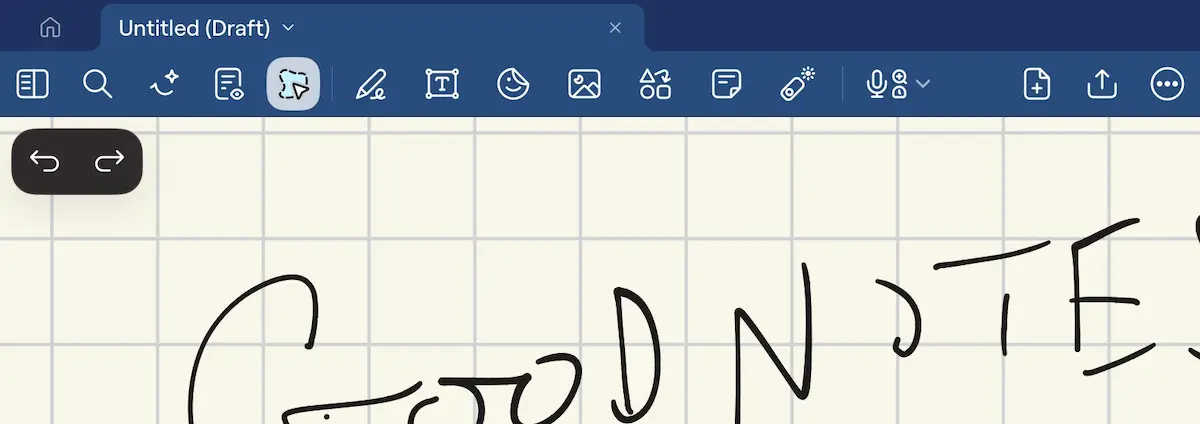
How to Convert Handwriting to Text in GoodNotes: Complete Guide (2025)
Last updated: November 26, 2025
Quick Start: Convert Your First Handwritten Note in Goodnotes
- Write something with your finger or stylus on any GoodNotes page
- Tap the Lasso Tool icon
- Circle the handwriting you want to convert
- Tap the circled selection → Tap "Convert" → Select "Text"
- Edit text if necessary, then tap "Convert" or "Copy Text"
- Done! Your handwritten text has been replaced with editable printed text
Read on for a more in-depth guide.
Method 1: The Lasso tool
The Lasso Tool is GoodNotes' original handwriting conversion method. It gives you precise control over which text to convert and when.
When to Use the Lasso Tool
✅ Converting existing notes you've already written
✅ Selecting specific sections of a page
✅ Converting notes written with messy handwriting (review before converting)
✅ Converting mathematical equations separately from text
Let's look at the process of converting handwritten text using the lasso tool in more detail.
Step 1: Activate the Lasso Tool
You can write in Goodnotes using a stylus (such as the Apple Pencil) or, if you don't have one, using your finger alone. You're now ready to use the lasoo tool.
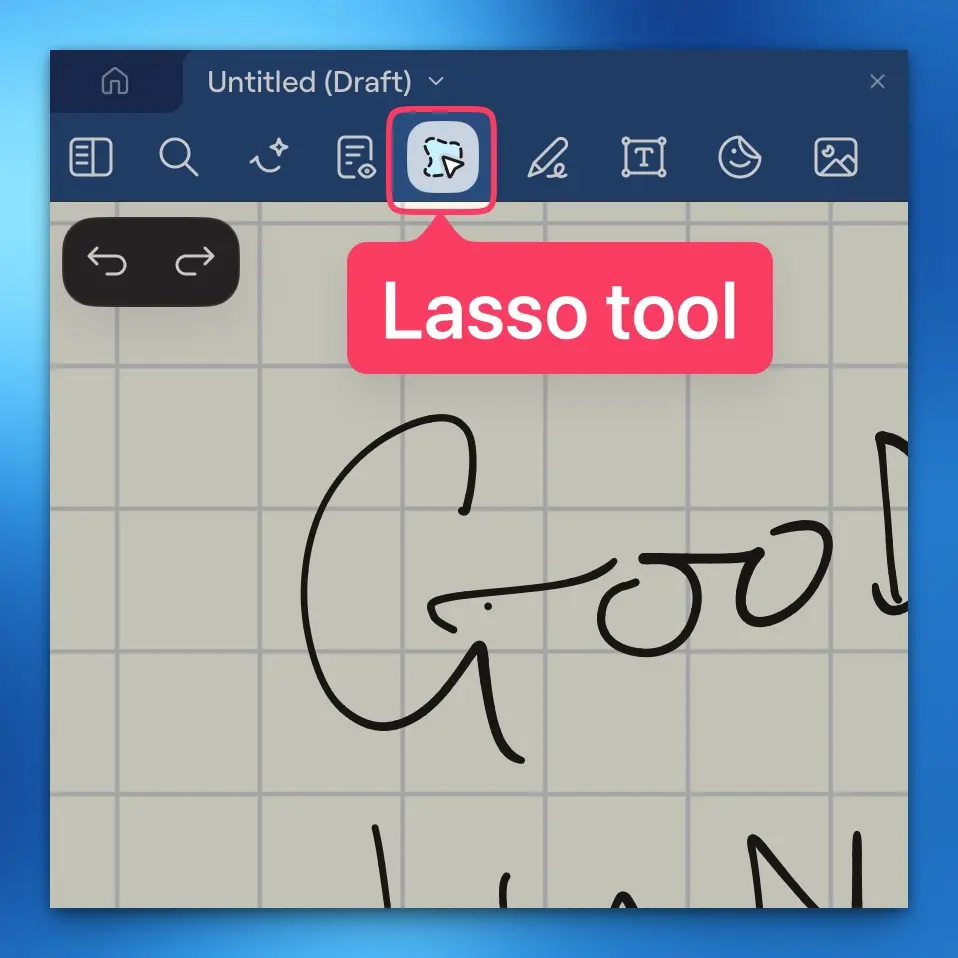
The Lasso Tool is located in the main toolbar. On iPad, it's usually the fifth or sixth icon from the left. On other platforms, look for an icon similar to the one in the screenshot below. Tap to activate it.
Your cursor will change to show it's in lasso mode.
Step 2: Lasso your handwriting
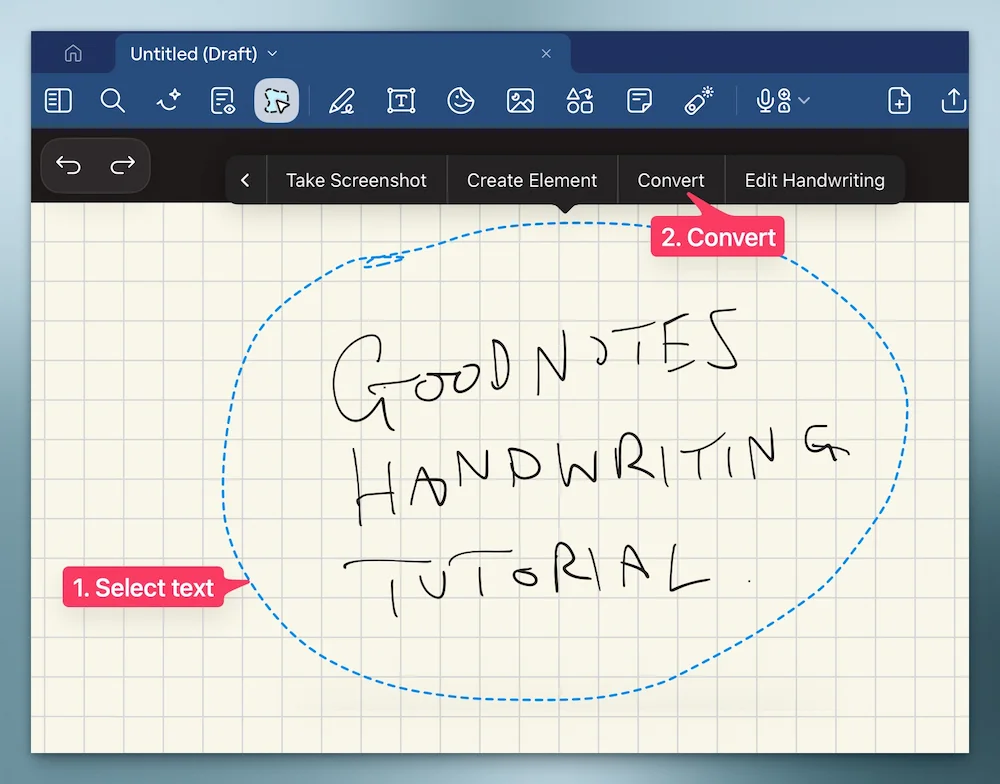
With the lasso tool selected, Circle the text you want to convert by drawing around it with your finger or stylus. You can:
✅ Select a single word
✅ Select an entire paragraph
✅ Select multiple sections by circling them all at once
💡 Pro Tip: Be generous with your selection - leave a little space around the edges to ensure all strokes are captured.
Step 3: Convert and replace text
Once selected, you'll see a blue dashed line around your selection. Next, long press on your handwriting until a menu appears. You'll need to choose the "Convert" option from that menu. Tap the right arrow to see more options if it isn't immediately visible.
You'll see two options:
- Text - Converts to regular typed text
- Math - Converts mathematical equations (keeps symbols like √, ∫, π)
Step 4: Review and Confirm
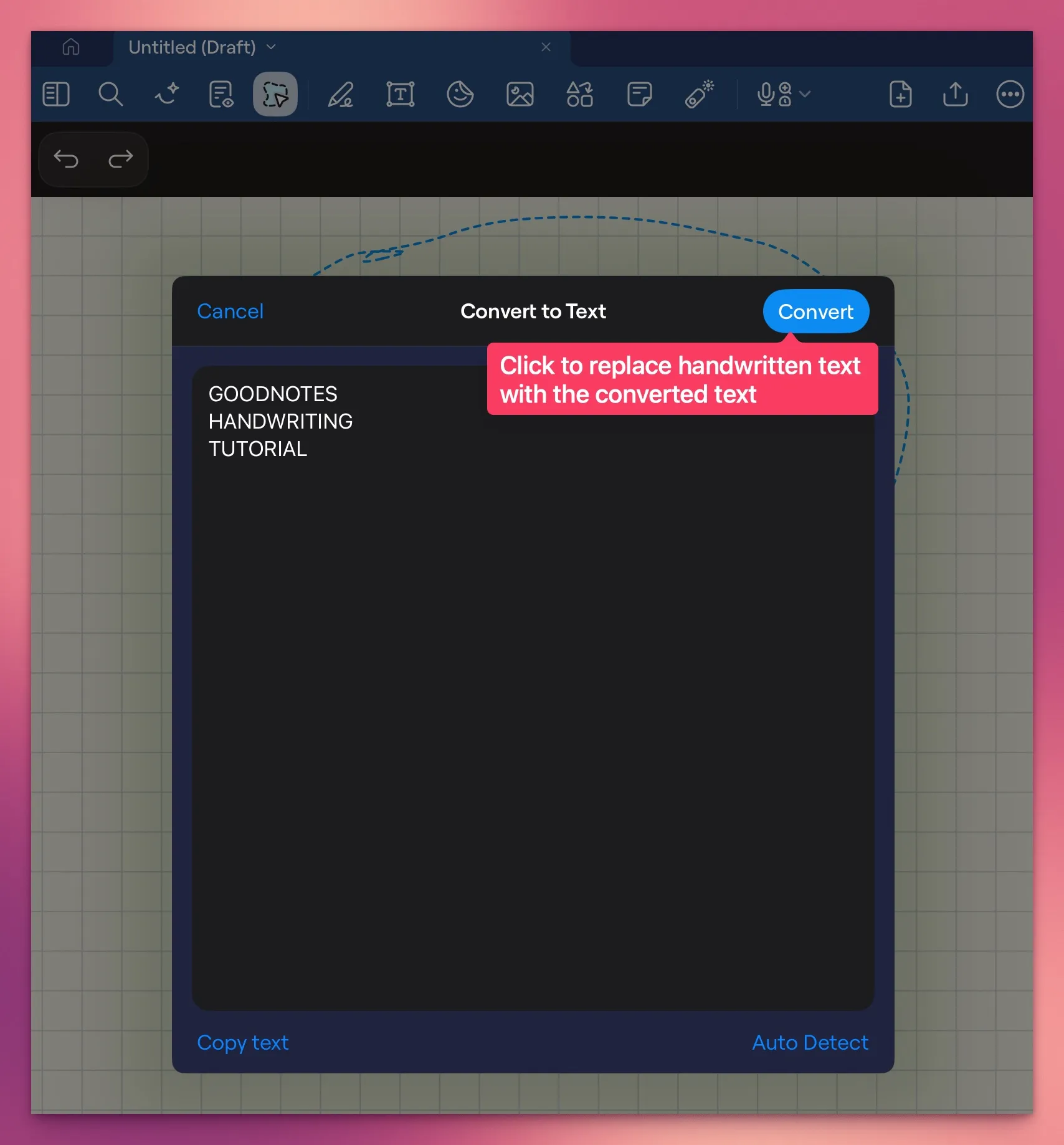
GoodNotes shows you a preview of the detected text. This is your chance to fix any errors. You can:
- Correct misrecognized letters by tapping and editing
- Add missing punctuation
- Fix spacing issues
When it looks good, tap "Convert" to replace your handwritten text with this transcription.
You can also press "Copy text" to copy the text to the clipboard without affecting your handwritten note.
Step 5: Place or Copy Your Text
After conversion, you have several options:
Option A: Replace handwriting with text
- Tap "Convert" to replace your handwriting with typed text
- The text maintains the same size, position, and color
Option B: Copy to clipboard
- Tap "Copy text"
- Paste anywhere (other apps, email, documents)
Limitations of the Lasso Tool
The lasso tool, while convenient, has some limitations.
⚠️ You must manually select each section
⚠️ Doesn't work in real-time (only after writing)
⚠️ Can be slow for converting large amounts of text
If you need automatic, real-time conversion, you'll want to use the Scribble tool instead.
Method 2: Automatic Conversion Using Scribble
Scribble is Apple's system-wide handwriting recognition feature that works inside GoodNotes' text boxes. Unlike the Lasso Tool, Scribble converts your handwriting to text automatically as you write - no selecting or converting needed.
When to Use Scribble
✅ Taking notes in real-time (lectures, meetings)
✅ When you want instant, clean typed text
✅ Creating forms or documents that need typed text
✅ When accuracy is more important than preserving handwriting
Scribble requirements
- iPad with iPadOS 14 or later
- Apple Pencil (required) or compatible stylus
- Scribble must be enabled in iPad Settings
Important
Scribble requires an Apple Pencil or compatible stylus. You cannot use Scribble with your finger. If you don't have a stylus, use Method 1 (Lasso Tool) instead, which works with finger input.
Step 1: Enable Scribble
Before using Scribble, you'll need to enable it in your iPad's settings. You'll only need to do this once. Here's how to do it:
- Open your iPad Settings app
- Navigate to Apple Pencil
- Turn on "Scribble"
- Optional: Tap "Try Scribble" to see a tutorial

Step 2: Create a Text Box
- Open your GoodNotes document
- Tap the Text Tool (T icon) in the toolbar
- Tap anywhere on the page to create a text box
- If the keyboards appear - don't use it, just start writing anywhere on the page with your pen
You'll now see your handwritten text appear as printed text inside the text box.
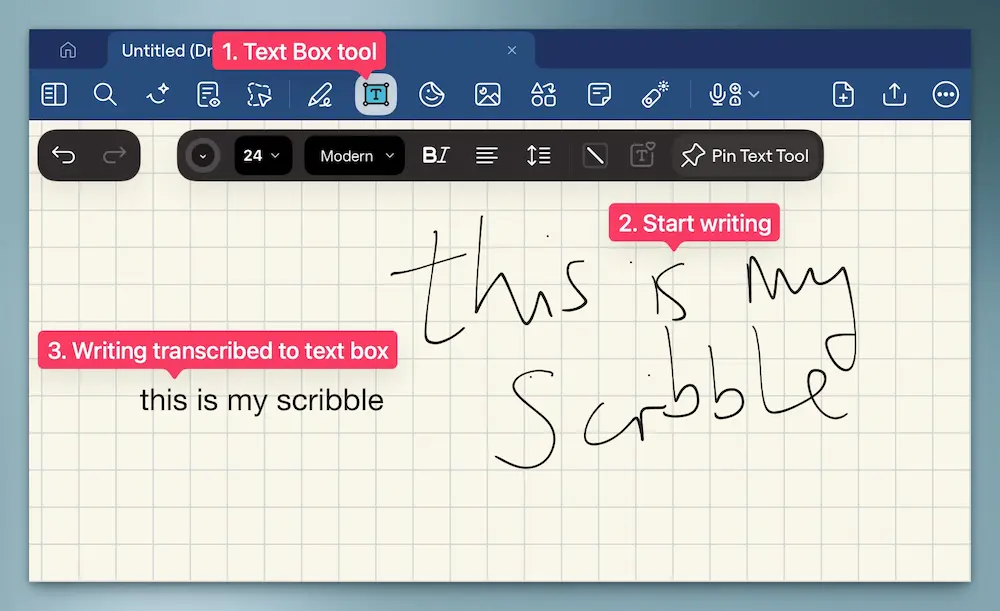
Step 3: Write with Your Apple Pencil
With an empty text box added to the page, you can now write anywhere on the page with your Apple Pencil and see that text appear as printed text inside the text box. Here are some tips to get the best results.
- Write naturally in cursive or print
- GoodNotes converts each word as you finish it
- Leave a small space between words
- Lift your pencil between words for best results
Step 4: Edit and Format
Since the text is already typed, you can:
✅ Use the Text Tool to change font, size, color
✅ Copy and paste anywhere
✅ Search for the text later
✅ Edit typos like normal typed text
No need to "convert" - it's already converted!
Scribble Limitations
⚠️ Requires Apple Pencil (won't work with finger)
⚠️ Only works inside text boxes (not on blank page)
⚠️ Less forgiving with messy handwriting than Lasso Tool
⚠️ iPad only (not available on Android/Windows yet).
For Android, Windows, or if you don't have an Apple Pencil, use Method 1 (Lasso Tool) instead.
Troubleshooting Common Issues
Even with perfect technique, you'll occasionally run into issues with GoodNotes' handwriting conversion. Most problems fall into a few common categories with straightforward solutions. This section covers the most frequently encountered issues and how to resolve them quickly.
"Convert" Button is Not Working
When you select handwriting with the Lasso Tool but the "Convert" option is grayed out or missing entirely, it's usually because GoodNotes doesn't recognize what you've selected as convertible handwriting. The app can only convert actual pen strokes you've made within GoodNotes - it cannot process text boxes, images, or imported content. This is one of the most common sources of confusion for new users who try to convert pasted images or typed text.
Possible causes:
- Nothing is selected - Make sure you've circled text with the Lasso Tool
- Wrong tool active - Switch to Lasso Tool, not Pen or Eraser
- Text box selected - Lasso only works on handwriting, not existing text boxes
- Image selected - You can't convert images of text, only actual handwritten strokes
Solution:
- Deselect everything and try again
- Make sure you're circling actual handwritten strokes
- If it's imported text/image, you need external OCR (see Section 9)
Poor Recognition Accuracy
If GoodNotes is converting your handwriting but making numerous mistakes, the issue is almost always with the input quality rather than the software itself. The OCR engine is highly sophisticated, but it can only work with what you give it. Messy handwriting, inconsistent styles, or incorrect settings will all produce poor results. Before assuming GoodNotes isn't working properly, review your writing technique and configuration settings.
Common causes:
- Handwriting too messy - Follow the tips in Section 5
- Wrong language selected - Check language settings match your writing
- Mixed cursive and print - Stick to one style
- Overlapping words - Leave space between words
- Outdated app - Update GoodNotes to latest version
Quick fixes:
- Try writing the same text more clearly
- Use larger writing size
- Select correct language in settings
- Enable "Auto-Capitalization" in iPad settings (for Scribble)
💡 Accuracy test: If GoodNotes consistently misreads your handwriting, you may need specialized OCR (see Section 9).
Scribble Not Working
Scribble-related issues are usually configuration problems rather than bugs. Since Scribble is a system-wide iOS feature rather than something built into GoodNotes specifically, you need to ensure it's properly enabled in your iPad settings. Additionally, Scribble only functions in text boxes - if you're trying to write on a blank GoodNotes page, Scribble won't activate because there's no text field for it to work in. The keyboard appearing when you touch the screen is also expected behavior when Scribble isn't active or when you're using your finger instead of your Apple Pencil.
Possible causes:
- Scribble not enabled - Check iPad Settings → Apple Pencil → Scribble = ON
- Not using Apple Pencil - Scribble requires official Apple Pencil or compatible stylus
- Typing with finger - If you touch the keyboard, it stays open
- Wrong iPad model - Scribble requires iPadOS 14+ on supported iPads
- In wrong app area - Scribble only works in text boxes, not blank page
Solutions:
- Enable Scribble in iPad Settings
- Dismiss keyboard, then write with Apple Pencil only
- Create text box first (tap T tool, then tap page)
- Update to iPadOS 14 or later
Converted Text Has Wrong Formatting
This isn't actually a problem - it's how GoodNotes is designed to work. The appearance of converted text depends on which conversion method you used. The Lasso Tool tries to match your original handwriting's characteristics to maintain visual consistency, while Scribble uses whatever text formatting you've set as your default. Understanding this distinction helps you choose the right method for your needs and know what to expect from each one.
Expected behavior:
- Lasso Tool: Text matches original handwriting size and color
- Scribble: Text uses your default text style
To change:
- Double-tap the converted text
- Use Text Tool (T icon) to modify:
- Font family
- Font size
- Text color
- Bold/Italic
- Alignment
Text Converts But Won't Copy/Paste
When converted text won't copy using the standard long-press gesture, it's usually because GoodNotes needs you to use its specific sharing workflow. The app treats converted text as a special object until you explicitly copy it through the Share menu. This extra step ensures the text is properly formatted for pasting into other apps.
Solution:
- Tap the converted text selection
- Tap the Share icon (square with arrow) at top
- Select "Copy"
- Now paste anywhere (GoodNotes or other apps)
Or:
- Long-press the converted text
- Select "Copy" from popup menu
- Paste in destination
Still Having Issues?
If you've tried the solutions above and are still experiencing problems, the issue may be more specific to your device configuration or a bug in your version of GoodNotes. In these cases, the standard troubleshooting steps - restarting apps, updating software, and contacting support - are your best options.
Try these:
- Restart GoodNotes app
- Restart your iPad/device
- Check for app updates
- Contact GoodNotes Support
- Visit GoodNotes Help Center
8 Tips for Maximum Handwriting Recognition Accuracy
GoodNotes' OCR technology is excellent, but like any handwriting recognition system, its accuracy depends heavily on the quality of your input. The difference between 70% accuracy and 95% accuracy often comes down to a few simple writing habits. These eight tips represent the most impactful changes you can make to dramatically improve your conversion results, based on extensive testing with different handwriting styles.
Write Clearly and Legibly
This might seem obvious, but it's the single biggest factor determining recognition accuracy. GoodNotes uses machine learning algorithms trained on millions of handwriting samples, but even the most advanced AI struggles with truly illegible writing. The good news is that "clear" doesn't mean "perfect" - you don't need calligraphy-level penmanship. You just need to make your letters distinct enough that a human reader would recognize them without guessing. Think of it as writing for someone who doesn't know your handwriting quirks.
Best practices:
- Print letters clearly or use neat cursive (not a mix)
- Make distinct letters - avoid ambiguous "a" vs "o" shapes
- Don't rush - take an extra second per word
- Use larger text when possible (easier to recognize)
💡 Test your baseline: Convert a sample paragraph of your normal handwriting, then try again writing more carefully. You'll see the difference.
Use Proper Spacing
Word spacing might seem like a minor detail, but it's actually one of the most critical factors in OCR accuracy. GoodNotes determines where one word ends and another begins primarily by detecting gaps in your writing. If your letters touch or run together, the OCR engine may interpret two separate words as one long word, or incorrectly split a single word into multiple parts. The algorithm looks for consistent patterns in spacing, so maintaining uniform gaps between words helps it make accurate decisions.
Proper spacing means:
- Leave clear gaps between words (about 1 letter width)
- Don't let letters from different words touch
- For Scribble: Lift your pencil between words
- Use line spacing if writing multiple lines
Avoid Mixing Styles Mid-Word
GoodNotes' OCR engine is trained to recognize patterns in handwriting styles. When you consistently write in one style - whether that's print, cursive, or something in between - the algorithm can better predict what you're writing based on the shapes it sees. However, when you mix styles within a single word, you're essentially asking the OCR to switch recognition modes mid-word, which significantly increases the chance of errors. Each handwriting style has different characteristic shapes for the same letters, and mixing them creates ambiguous combinations.
Consistency = accuracy:
❌ Don't: Start with cursive "h" and finish with print "ello"
✅ Do: Use all cursive "hello" or all print "hello"
GoodNotes trains on consistent writing styles. Mixing styles confuses the OCR.
Keep GoodNotes Updated
GoodNotes' development team continuously improves the OCR engine with each software update. These improvements are based on real-world usage data and machine learning refinements that make the recognition algorithms smarter over time. Updates often include enhanced accuracy for specific letter combinations that previously caused problems, better support for different handwriting styles, and improved processing speed. Running an outdated version means you're missing out on months or even years of OCR improvements.
Stay current:
- Go to App Store/Google Play
- Check for GoodNotes updates
- Update immediately - OCR models improve with each version
- Enable automatic updates
Fun fact: GoodNotes 6.0 → 6.5 improved recognition accuracy by ~15% for cursive handwriting.

Select the Correct Language
GoodNotes uses language-specific recognition models that are optimized for the letter patterns, common words, and grammatical structures of each supported language. When you set your language correctly, the OCR engine can use contextual clues to improve accuracy.
For example, in English, "the" is a much more common word than "tbe," so if your handwriting is ambiguous, the engine will favor the more common word. However, if your language setting is wrong, these contextual clues work against you, and the OCR may select words that don't make sense in your actual language.
Goodnotes comes with only a limited number of preinstalled languages. make sure that yours is installed, and add it if not.
Configure your language:
- Go to GoodNotes Settings
- Tap "Document Language
- Make sure your primary writing language is installed
- (Optional) Select your primary language as the default for Nnew documents
- GoodNotes optimizes OCR for that language
💡 Multilingual notes? GoodNotes can recognize multiple languages in the same document, but selecting your primary language helps.
Use a Pen (if you have one)
The hardware you use to write makes a significant difference in OCR accuracy. Apple Pencil and other high-quality styluses provide precise input with pressure sensitivity, tilt detection, and palm rejection that helps GoodNotes capture the exact shape and flow of your writing. This precision translates directly to better recognition. While finger input works in a pinch, your finger lacks the fine point and pressure control of a stylus, which can result in thicker, less precise strokes that are harder for the OCR engine to interpret accurately.
Tool quality affects recognition:
- Apple Pencil / Stylus: Best results (pressure sensitivity helps)
- Finger: Works, but less precise (write larger)
- Cheap stylus: Inconsistent pressure may cause recognition issues
Recommended: Apple Pencil (Gen 1 or 2) or Logitech Crayon
Write at a Consistent Size
GoodNotes' OCR engine is optimized for handwriting within a certain size range. Very tiny writing (under 3-4mm tall) may lack enough detail for accurate recognition, while extremely large writing can confuse the letter detection algorithms. Finding a comfortable, medium size - similar to what you'd write on lined notebook paper - gives the OCR the clearest signal to work with. Consistency in letter sizing also helps, as dramatic size variations within the same word can make it harder for the algorithm to determine what's a capital letter versus lowercase.
Optimal sizing:
- Best: 5-8mm letter height (standard notebook writing size)
- Works: 3-10mm letter height
- Problematic: Under 3mm (too small, detail loss) or over 12mm (too large, harder to process)
- Consistency matters: Keep letter sizes uniform within words
💡 Pro tip: GoodNotes templates with ruled lines help maintain consistent sizing naturally. If you're using blank paper templates, consider adding light guide lines.
Review Before Converting (Lasso Tool Only)
One of the most valuable features of the Lasso Tool is the preview screen that appears before final conversion. This preview shows you exactly what GoodNotes has interpreted from your handwriting, giving you the opportunity to catch and correct errors before they become typed text. Taking five seconds to review this preview can save you minutes of editing later, especially for longer passages. Common patterns emerge - you might notice that GoodNotes consistently misreads your "a" as "o" or your "rn" combination as "m" - and you can correct these systematic errors at the preview stage.
The preview screen is your friend:
When using the Lasso Tool:
- Always check the preview before clicking "Convert"
- Fix obvious errors (wrong letters, missing spaces)
- It's faster to fix 2-3 errors now than re-convert later
- Common fixes: "rn" recognized as "m", "1" vs "l", "0" vs "O"
With Scribble: You can edit typos after conversion like normal text.